
Smart Manufacturing Tour
Explore end-to-end production processes, from ERP integration and part manufacturing to intralogistics, assembly, and final testing.
The Smart Manufacturing Tour has been developed to guide visitors through the first steps of our personalized drone production processes while introducing them to the key principles of smart manufacturing (Industry 4.0 to 5.0).
During the tour, guests discover a variety of use cases along the entire value chain. Some stations highlight software-driven solutions, while others showcase hardware-focused innovations or advanced production technologies. Each station features a QR code that links visitors directly to this webpage for additional information and insights.
Process overview
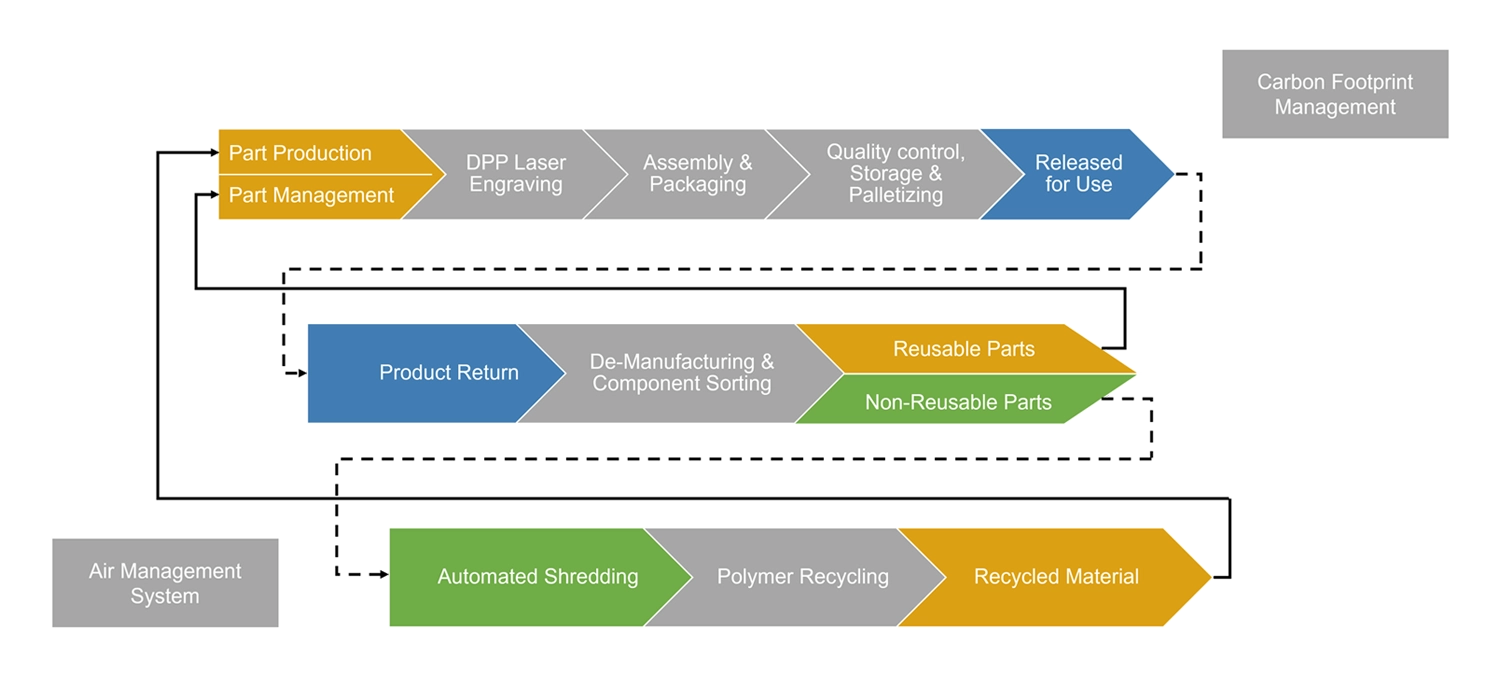
In previous years, our production process followed a mostly linear model. Even though we operated a functional demonstration system, each cycle required us to manufacture a completely new drone from scratch. With the updated system, we are moving toward a circular production model where products are brought back into the loop instead of being rebuilt from zero.
Depending on the business model, a drone may be returned for routine maintenance, necessary repairs, or complete reconditioning. Returned products first pass through a dedicated de-manufacturing stage, where they are carefully disassembled and each component is assessed. Functional parts re-enter the production flow, while damaged parts move into material recovery.
To close the loop, we added a polymer-recycling workflow. Damaged plastic components are shredded, dried, extruded, and transformed into new 3D-printing filament. These recycled materials feed directly into our 3D printers, enabling us to manufacture new components from the polymers recovered on-site. This completes the circular process and reduces environmental impact.
1. ERP & MES
The Enterprise Resource Planning (ERP) software is the start of the Lighthouse Factory journey. Customers configure their drone variant including model, color and engraving. Configurations are processed in two ERP systems, Proalpha and Abacus, and are linked to a cloud-based Manufacturing Execution System (MES) built with FlowFuse as the industrial wrapper around Node-RED. Orders and configuration data are transferred digitally into production and status feedback is sent back from selected stations. The demonstrator shows how product configuration, ERP and MES can be combined into a consistent digital thread from order entry to manufacturing feedback.
2. Production Container
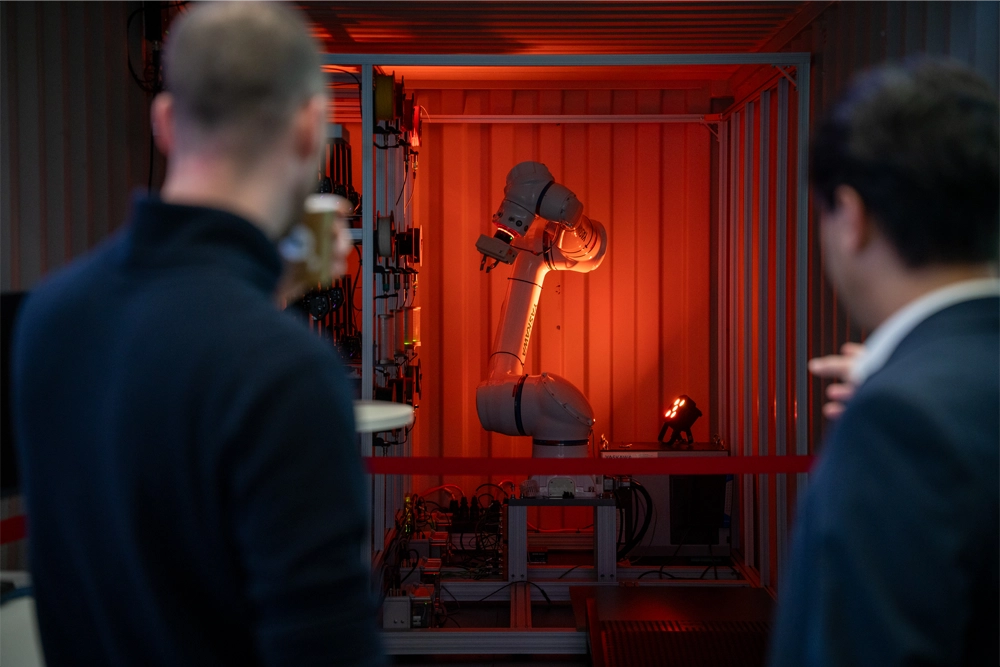
The Production Container is a next‑generation mobile 3D‑printer farm with 12 FDM printers handling PLA, ABS, and other materials. Automated with WANDELBOTS’ NOVA and a Yaskawa HC20 cobot using a Zimmer gripper, it selects printers by material and color, oversees prints, and moves finished parts once the MES, built on FlowFuse, releases an order. This Station features a cabinet free design combining IPCs and IO-Link sensorics.
For DPP laser marking, an Axnum SIC green‑laser cell engraves Data Matrix codes on drone components such as PCBs, aluminum, and polymer parts. An ABB IRB 1010 robot with a Schunk gripper programmed in AICA Studio is integrated for automated loading.
Each mark acts as a Digital Product Passport, enabling part‑level traceability, showing reuse or recycling history, and supporting future use cases like maintenance, digital twins, and sustainable manufacturing.
3. Post Processing
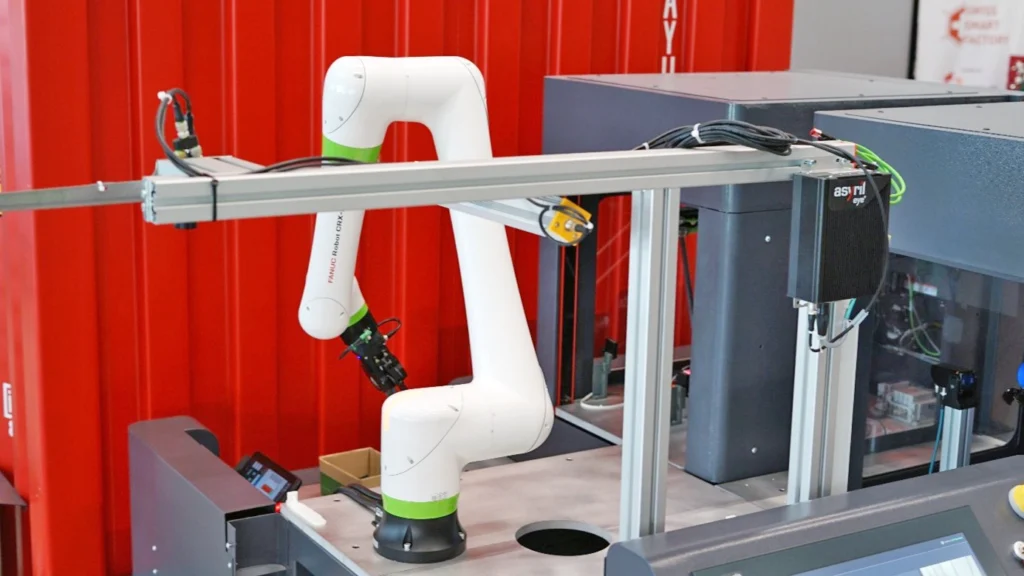
This post-processing demonstrator at the Swiss Smart Factory, originally built by Seb’Automatisme, was retrofitted with modern automation technologies within only a few weeks.
The station features a Fanuc CRX-20iA/L collaborative robot with a 20 kg payload, equipped with an Apicoo gripper and programmed using Wandelbots NOVA. Wireless 5G connectivity from Siemens and the new Asiryl EYE+ vision system enable reliable pallet detection on the back of the robot dog.
The retrofit also included integration with the machine’s OPC UA servers and an interface for autonomous robot dogs to deliver and retrieve pallets between production steps.
4. Robodog for Intralogistics
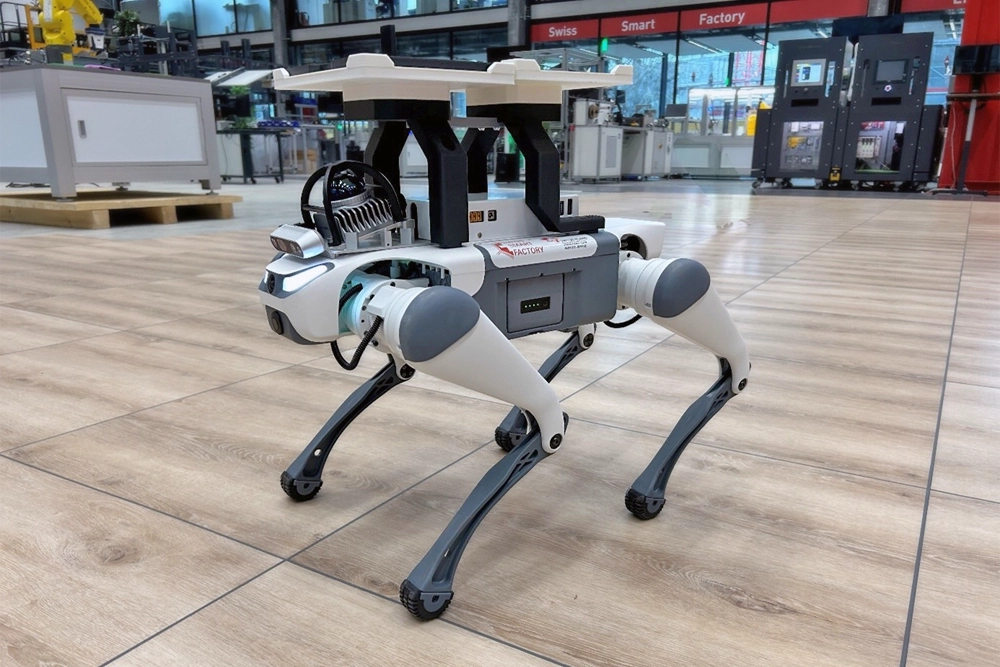
Quadruped robots are game changers in the field of inspection and autonomous navigation as they can easily walk over obstacle over autonomous transportation system can’t. At the Swiss Smart Factory, we have started integrating them with handling robotic system, to ensure small workpiece pallets transportation.
5. Flexi-THT Soldering Station
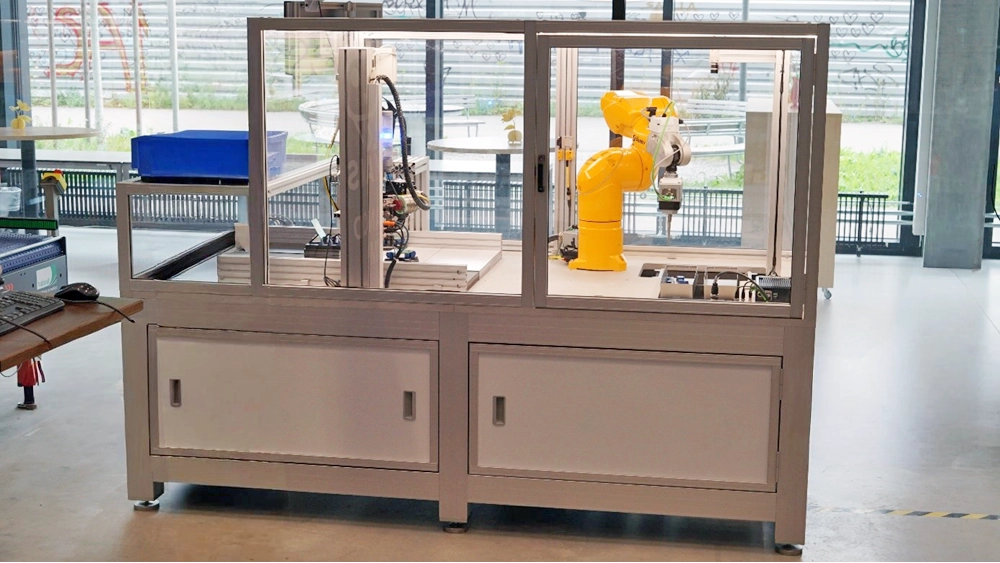
Flexi-THT is a modular through-hole technology line that shows how new PCB types can be introduced very quickly. A flexible Beckhoff XPlanar transport system, Stäubli TX2-60 with Schunk gripper handling system, Asyril Asycube with EYE+ flexible feeder and a mta robotics selective soldering head are combined. Parameters for new PCB designs are extracted from digital data such as bill of materials and Gerber files by a software agent. Missing data is completed with the user and then sent directly to the machine. The goal is to reconfigure the line for a new product variant in roughly half an hour and to serve as a platform for data-driven process optimization and intelligent soldering heads with integrated quality control.
6. Manual workstations
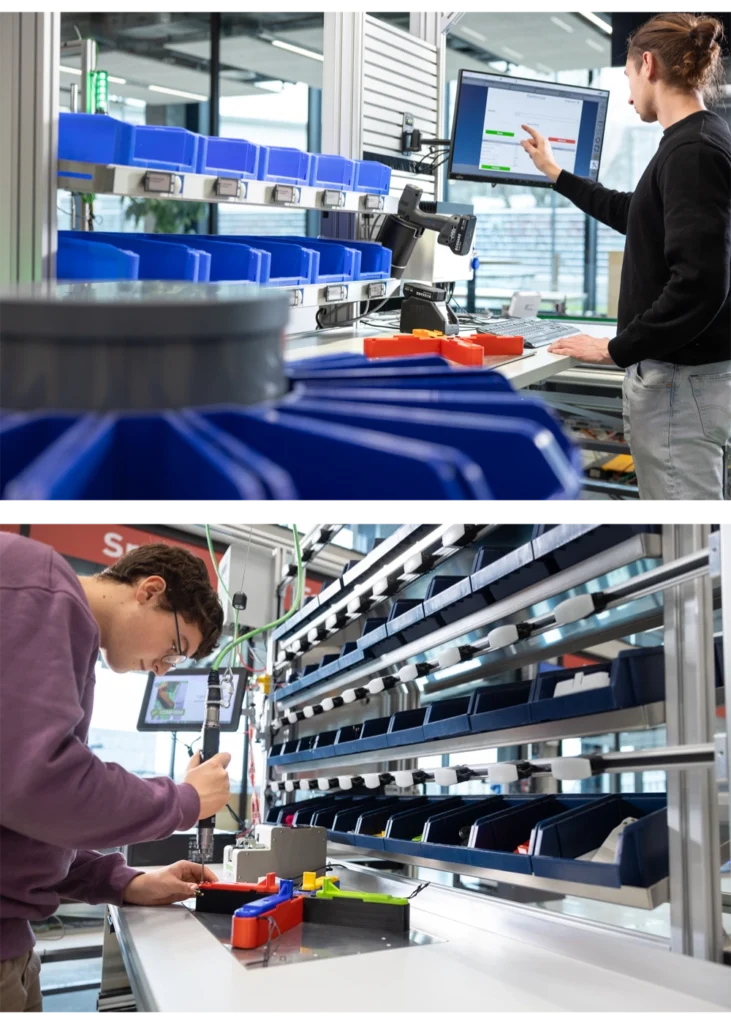
These two stations from Phoenix Mecano and Bossard guide operators through the final assembly and packaging of the drone. In the Bossard version, a rotary table offers several positions for manual tasks. An AxNum smart screwdriver with torque monitoring is used for critical fastenings. A smart trolley with integrated scales under each box detects when parts are taken and automatically advances the digital work instructions. The concept offers more storage capacity than classic kitting and supports different product variants. A tablet interface can host assistance applications such as an LLM-based helper for work instructions and checklists.
7. Humanoid Fastening
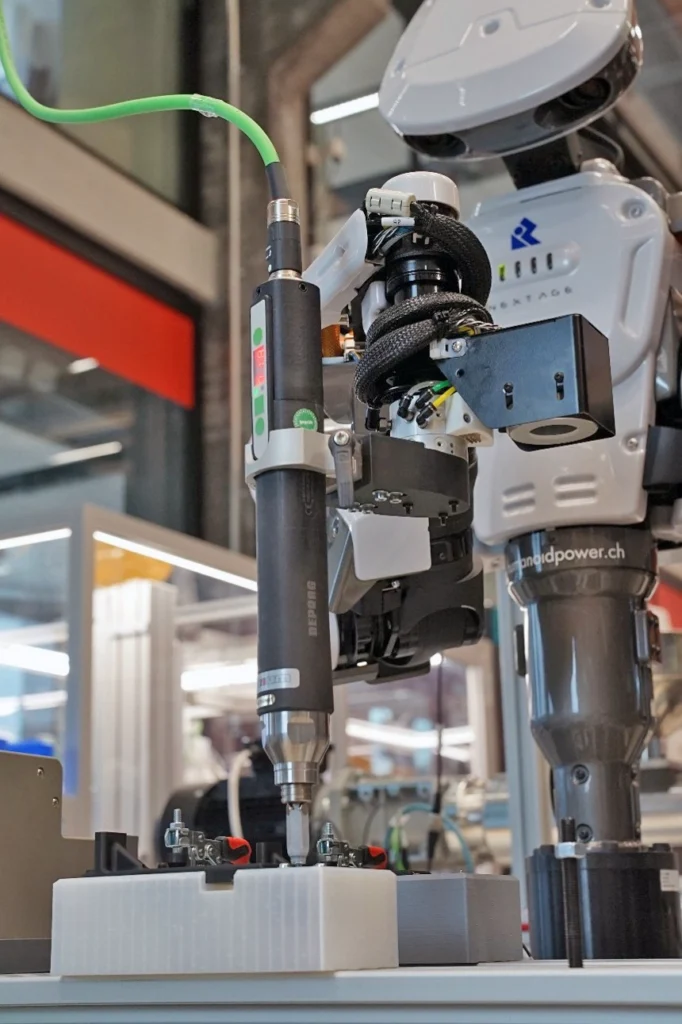
This cell uses a Kawada Nextage humanoid robot from ERT Solutions to fasten screws on drone arms. A dedicated fixture keeps motor and arm precisely aligned so that the screw holes match. A stereo camera in the head detects reference markers at the screw feeder and defines a coordinate frame. Mono cameras in the arms detect the screw holes and the screws. The robot picks a screw from the distributor and fastens it with the AxNum screwdriver with controlled torque. The cell is designed so that both arms can later be used in parallel. It demonstrates humanoid robot programming, robust fixturing and camera-based positioning for collaborative assembly scenarios.
8. Part Sorting
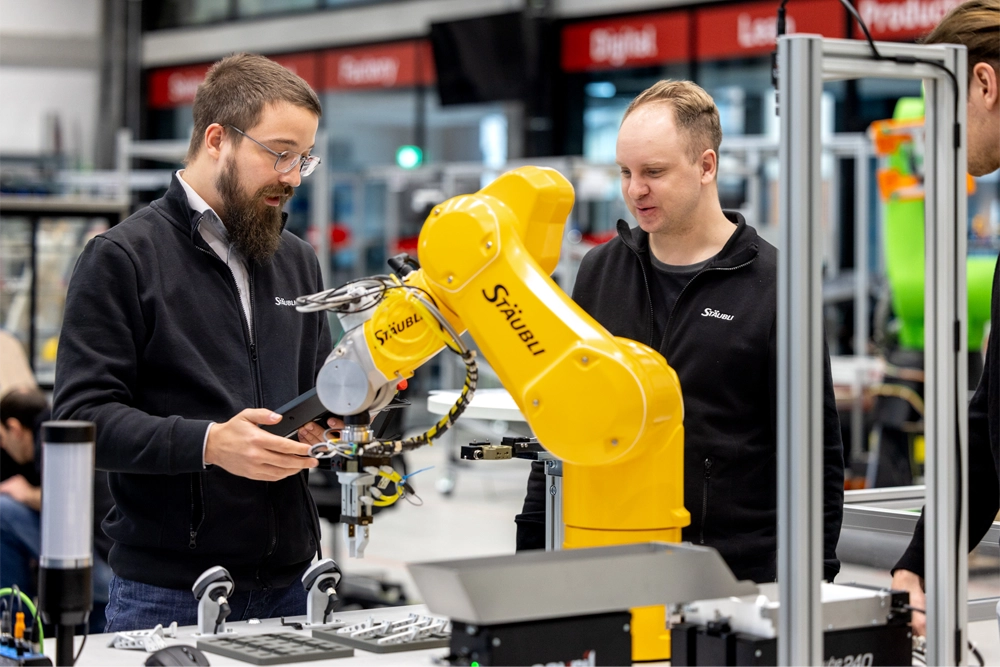
The flexible parts sorting cell automates simple pick and place tasks that are still often performed manually. It is currently configured with small watch parts that are sorted and placed onto trays or pallets. The Stäubli TX2-60 robot is programmed with VAL block low-code tool so that new processes can be defined in a few hours. Trajectories, gripping strategies and target layouts can be adapted quickly to new parts. The cell is suitable for high-mix, low-volume environments and shows how intuitive robot programming and modular tooling enable cost-efficient automation of labor-intensive tasks. An Asyril Asycube with EYE+ flexible feeder takes care of the work of finding the parts from bulk.
9. Drone Testbed
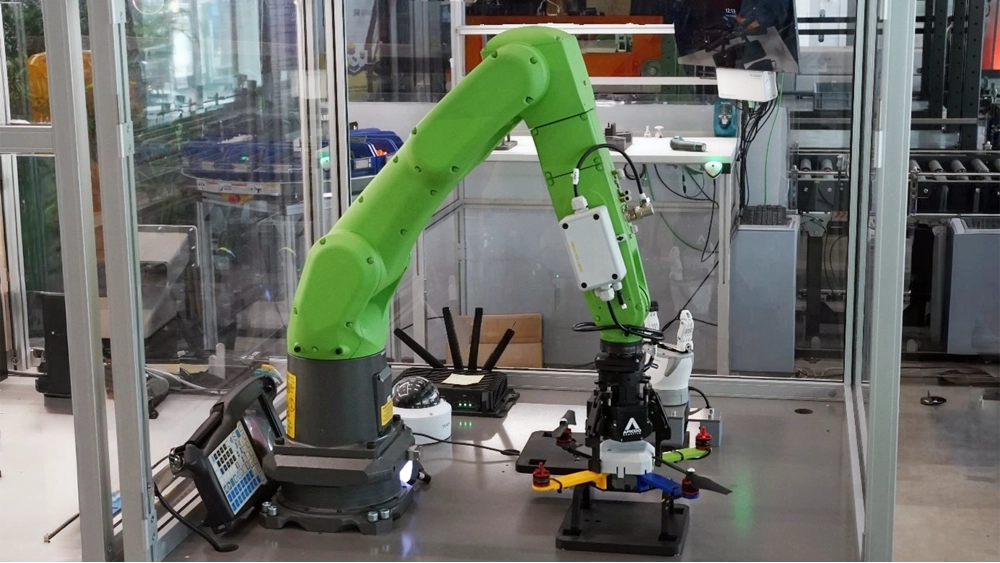
The drone test bench verifies that every assembled drone is complete and functional. A Fanuc CR7 robot with a 3-finger Apicoo Robotics gripper picks the drone from the conveyor, performs a weighing step and compares the result with a target value. In a second step the drone is clamped in a dedicated gripper, the motors are started and a force sensor measures the thrust from the propellers. Analyzing the force profile allows malfunctioning motors or propellers to be identified. The demonstrator combines robot handling, weighing, force measurement and motor control in a realistic end-of-line scenario and is also used as a 5G communication use case.
10. Collaborative Palletization
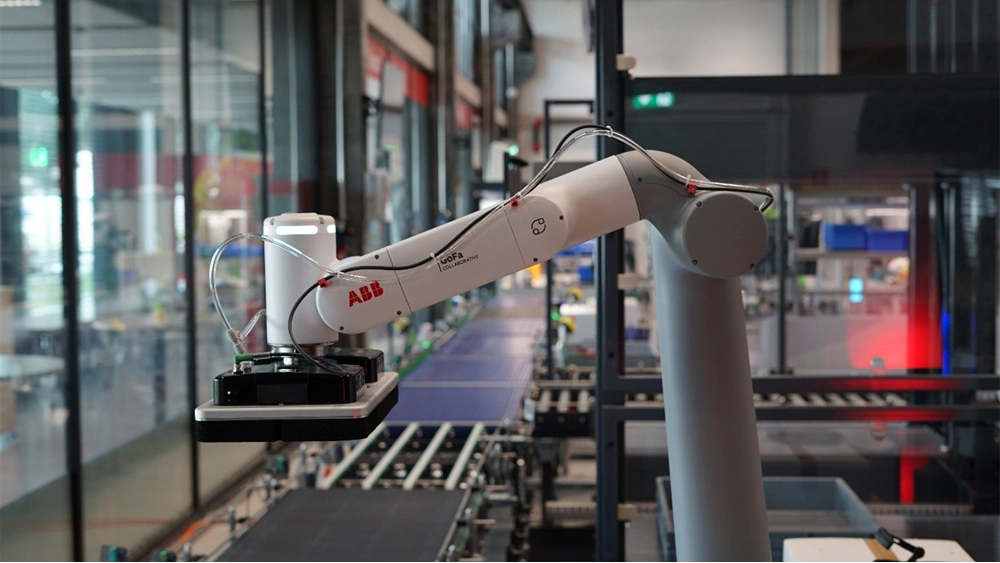
This demonstrator shows an end-to-end material flow from storage to outbound shipping. The system is modular and uses intelligent logic to place frequently used boxes near the loading points. At the palletizing station an ABB GoFa collaborative robot with SMC Vacuum pad builds mixed pallets according to orders and, in a full scenario. The cell is also a use case for Realwear AR glasses, Augment IT user guidance tool and user-friendly cobot programming with solutions such as AICA.
11. 5G Infrastructure
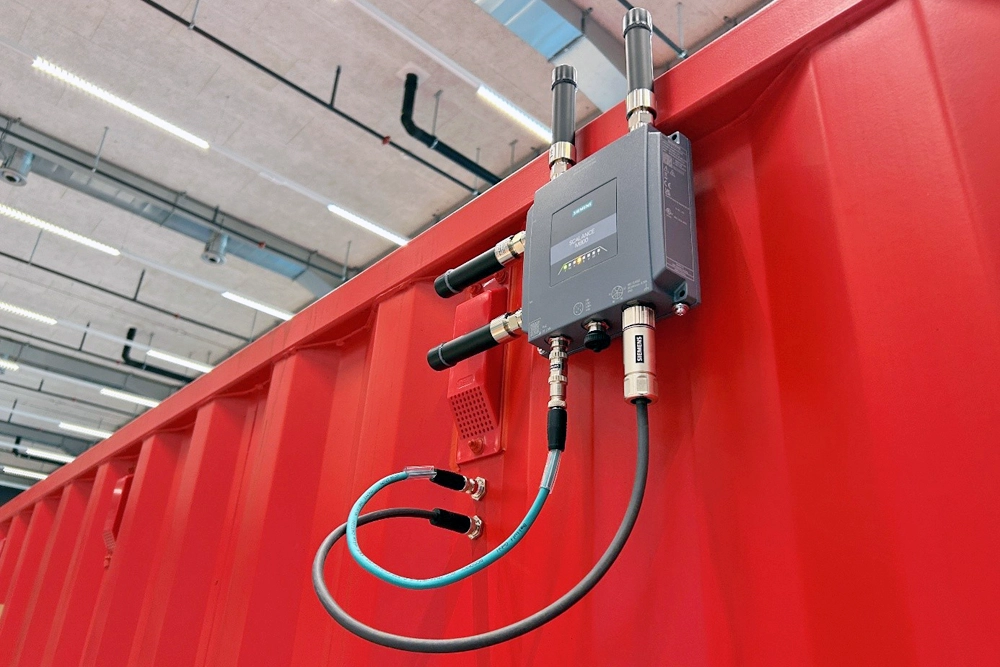
Private Industrial 5G enables full control over data and network configuration, with Siemens and Dätwyler providing a complete ecosystem including the 5G core, radio units, and routers. It supports demanding applications in manufacturing, intralogistics, and process industries by ensuring all communication remains on‑site for maximum privacy and flexibility. The industrial‑grade equipment is built for harsh environments and easy maintenance without specialized knowledge. Using open standards, the fully integrated Siemens system allows seamless third‑party device integration and scalable expansion to match evolving operational needs.
12. UWB Localization
The UWB localization system tracks active tags in three dimensions across the hall. Several antennas mounted near the ceiling receive ultra-wideband signals from compact tags. The system is robust against reflections from metal structures and machines, which makes it suitable for industrial environments. Position data is available via a REST API and can be integrated into factory IT systems. The demonstrator shows how mobile objects such as containers, tools or boxes can be located with high accuracy and used for process transparency and optimization.
